
The case for Placemaking
The UK is addressing regional economic disparities through Local Growth Plans and Place-Based Business Cases, guided by the Modern Industrial Strategy. This paper emphasises the need for collaboration among national and local authorities, integration across sectors like housing, transport, and health, and adherence to updated Green Book principles, including broader Social Value and environmental considerations. Building capacity within Local Authorities is essential, with partnerships and community engagement underpinning programme deliverability. BearingPoint has launched a benchmarking survey to assess readiness and capability for delivering impactful PBBCs.

Executive Summary
The UK faces a significant economic gap, with long-term regional growth seen as the sustainable solution, delivered through the Government’s Modern Industrial Strategy.
From 2026, Local Growth Plans (LGPs), will serve as strategic frameworks for collaboration and investment to stimulate economic growth in regions. They will be owned and delivered by Mayoral Strategic Authorities. Place-Based Business Cases (PBBCs) will be central to understanding and prioritising growth opportunities and will be key to unlocking IS8 funding.
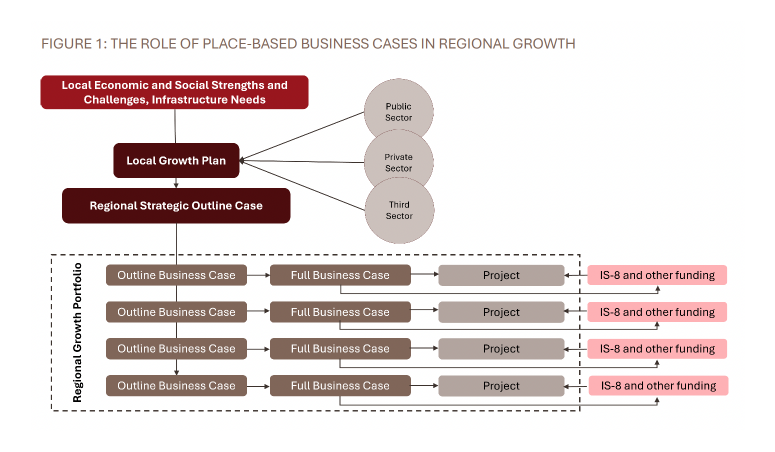
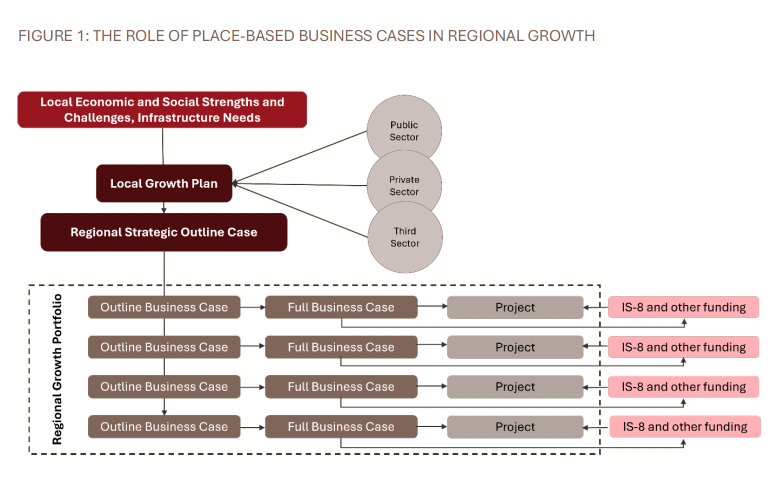
PBBCs will follow the Five Case Model and Green Book principles, integrating housing, transport, education, and health. Collaboration is crucial – HM Treasury, MHCLG, DfT, DHSC, Police and Crime Commissioners must collaborate with Authorities to join-up planning and delivery.
While LGPs are emerging, Regional Strategic Outline Cases (Regional SOCs), covering a defined geographical area, are an ideal model to enable delivery of 10–15-year strategic growth projects, access funding, and enable their effective management as a cohesive portfolio. Prioritised project and programme cases will then progress from OBC to FBC based on deliverability and their contribution to economic and social outcomes. Stalled projects will be reviewed, reprioritised and potentially halted where there is insufficient future Value for Money (VfM).
Following updated Green Book 2026 guidance this requires a move beyond traditional cost-benefit analysis to include difficult-to-monetise Social Value, wellbeing, civic pride, and environmental impacts on communities, businesses, and citizens. Regional SOCs should address issues of regional inequality and address aspirations for a more balanced UK economy, through interventions tailored to local needs. Economic appraisals must use broader VfM assessments and social cost-benefit analysis techniques aligned with the 2026 Green Book. The business cases must be evidence-led and focused on specific local conditions.
Community engagement, and collaboration between public and private sectors are essential for legitimacy, local buy-in, and deliverability of programmes. Robust monitoring and evaluation is crucial to maintain critical mass, pace of delivery, impact evaluation, and accountability.
However, Local Authorities face shortages in key skills and capacity to develop these business cases to a robust standard. Partnerships with third parties in the private and academic sectors will therefore be necessary to help build capacity and capability over time, as well as to understanding the art of the possible in regional economic growth.
With this in mind, we have developed a short survey to help Authorities assess their readiness and capability to deliver PBBCs. All respondents who complete the survey will receive an update to this report benchmarking how their Authority compares to other (anonymised) Authorities in terms of readiness to deliver robust and impactful PBBCs.
The survey can be accessed here: https://forms.office.com/e/2EYWrYsPd8
The case for Placemaking
Context and background
Effective place-based investment requires tailored growth strategies that address the unique needs and opportunities of each locality. This means moving from delivering loosely co-ordinated projects to establishing integrated, holistic portfolios that consider how various housing, transport, education, health infrastructures, and employers interact within a community to deliver cumulative impacts. The very nature of this work makes collaboration across central, regional, and local government essential, and requires support from national bodies and the private sector where analytical capability is limited. Engaging the private sector and local stakeholders is also crucial to understanding drivers and blockers to local economic growth.
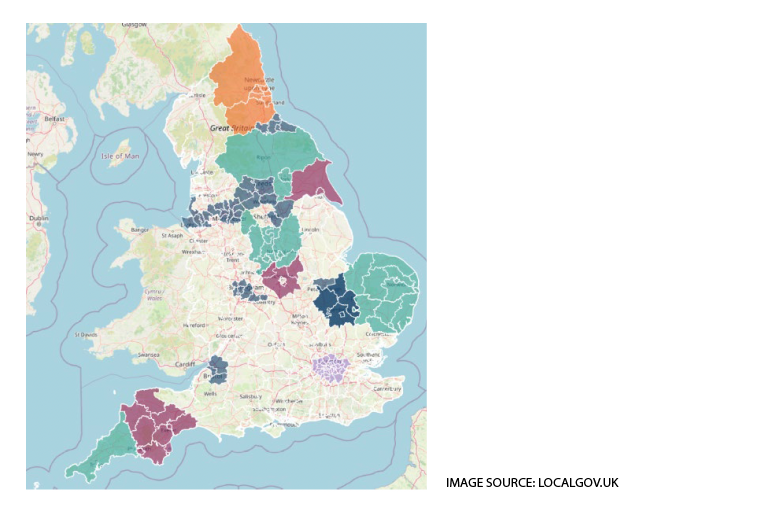
Examples of comprehensive Local Growth Plans are already emerging. For example, the West Yorkshire Local Growth Plan has the aim of tackling low pay and improve connectivity through “corridors of opportunity”. This will be achieved by introducing a Mass Transit System, bringing buses back into public control, and establishing a Green Jobs Taskforce to create 1,000 jobs. Focusing on Digital/Healthtech and creative industries, the West Yorkshire Investment Zone is expected to unlock £220 million in investment and create over 2,500 new jobs.
The Greater Manchester ‘Good Growth Plan’ focuses on reindustrialising the region through five global clusters, supported by a £1 billion “Good Growth Fund”. Key initiatives and strategic developments include a £400 million first-wave investment for nearly 3,000 new homes, 22,000+ jobs, and 2 million square feet of employment space, “Atom Valley” for advanced materials and manufacturing, the regeneration of town centres like Stockport and Stretford and expanding the Metrolink and integrating suburban rail into the “Bee Network”.
The London Growth Plan 2025-2035 aims to make London’s economy £107bn larger by 2035 and create 150,000+ good jobs by 2028, through investment in “industrial innovation corridors” (e.g., WestTech in White City, Thames Estuary), building rent-controlled Key Worker homes, and a £21m boost for high streets. The overarching goal is to restore productivity growth to 2% per year.
Launched in October 2025 and acknowledging its strong baseline, the York and North Yorkshire 10-year Growth Plan focuses on becoming a ‘trailblazing City Region Rural Powerhouse’ by identifying sectors to accelerate growth including food and farming innovation, clean energy, and rail innovation with the goal of delivering better quality, secure jobs and more affordable housing.
The West of England Growth Strategy targets 15% employment growth in core sectors and aims to create 72,000 new jobs. The region will establish an AI supercluster and a ‘Rural Productivity Incubator’, focusing on the West Innovation Arc and the Severn Estuary, and building a £500m ‘Future Places Fund’ for land unlocking.
The North East Combined Authority Growth Plan 2025 focuses the region on becoming a leader in the low-carbon economy and becoming designated as an AI Growth Zone, aiming to unlock up to £30 billion in investment and exceeding national averages for Foreign Direct Investment.
Common themes in development of these plans are the use of devolved, flexible funding (e.g. Mayoral Revolving Growth Funds) to fast-track prioritised projects, with a clear focus on regional strengths and issues, and alignment of new housing and commercial developments with transport improvements.
While LGPs are emerging, it is as yet unclear how accountability for delivery will be achieved locally or nationally with any degree of consistency or rigour. This in turn requires consistency and rigour in Authorities’ approaches to investment appraisal and to allow national bodies to prioritise and evaluate and demonstrate Value for Money in return for their funding.

Local Growth Planning: What next?
The next phase of local growth planning demands bold vision, inclusive engagement, and a steadfast commitment to evidence-led decision making. This requires strong partnerships between public authorities and private enterprises, creating a dynamic environment where shared ambitions can flourish.
As well as being a key requirement to access IS-8 funding11, deliverable Local Growth Plans (LGPs) serve as the central framework for regional collaboration. For Mayoral Strategic Authorities, the statutory requirement to develop LGPs ensures that strategic vision is embedded in their governance, while non-devolved areas are equally encouraged to articulate clear, compelling plans for their future. By setting out their unique strengths and challenges, these Authorities can attract targeted investment, foster innovation, and catalyse sustainable economic growth that reflects the distinct character and aspirations of each place. The LGPs must also emphasise regional priorities and distinctive local strengths, in alignment with national objectives, and must respond directly to the lived experience of communities.
The LGP will be the ‘guiding star’ that provides strategic direction and growth forecasts on which the authority will be held to account by their electorate. But there is a clear need for infrastructure investment to enable these plans to be delivered, and this needs to be seen to deliver Value for Money (VfM) from the already stretched public purse.
Place-Based Business Cases
Place-Based Business Cases are an ideal model to enable definition and prioritisation of a portfolio of local growth projects over 10-15 years. They must be drafted with both technical precision and a deep understanding of the unique characteristics of each locality. The 2025 Green Book review principles encouraged a broader view in investment appraisal, valuing local intelligence and balancing quantitative rigor with qualitative insight. This has now been codified in the 2026 Green Book. By focusing on outcomes that matter to residents, such as tackling unemployment and boosting skills, authorities will be empowered to create business cases that inspire confidence and investment, and deliver lasting Placemaking impacts for local communities, businesses, and citizens.
Integrating evidence-based planning with local insights allows for a more nuanced understanding of the challenges and opportunities in different areas. Rather than relying on traditional Cost-Benefit and VfM analysis, this approach demands a comprehensive look at long-term social and economic effects within the local context, relying not just on broad assumptions but on specific data, real-life experiences, and modelling of future scenarios.
By adopting a systems-thinking perspective to enable a holistic view of the impacts of interactions in the local economic ecosystem, Authorities can invest in a balanced, prioritised portfolio of targeted interventions that build resilience, nurture social capital, and foster innovation. This will help in identifying tailored solutions for local issues such as structural unemployment, skills mismatches, health and education impacts, and infrastructure maintenance.
Sustainable economic growth depends on the quality of these investments, their grounding in robust, place-specific analysis, responsiveness to community input in their planning, and adaptability to uncertainty. Encouraging a culture of innovation and flexibility is also essential, with local areas experimenting with new governance models, financial mechanisms, and partnerships. Robust mechanisms must be in place to track and evaluate impacts over time, enabling in-flight adjustments and course corrections to be identified and made as needed.
Green Book methods and how they support Placemaking
There are established methods and processes for evaluating these investments. The Green Book 2025 review emphasised the increasing importance of a more holistic approach to considering, modelling, and measuring strategic outcomes and their impacts on communities. This approach has now been codified in the 2026 Green Book.
The 2026 Green Book approach enables Authorities to make clear, evidence-based statements about the desired outcomes of the LGP. It shifts focus away from traditional Cost-Benefit ratios and requires holistic evaluation of the benefits of wider investments in the unique social, economic, and environmental fabric of each locality. Meaningful engagement with stakeholders – residents, businesses, and community organisations – must therefore be embedded throughout the business case development process.
The approach also requires Authorities to revisit previous business cases for projects currently on hold. They must evaluate them without regard to sunk costs, discontinuing them if they do not demonstrate continued Value for Money.
Specific Considerations in Regional SOCs:
Regional Strategic Outline Cases (Regional SOCs) should act as a programme business case over a 10–15-year timeframe, covering a defined geographical area, and enabling growth projects to be managed as a cohesive portfolio designed to deliver region-specific growth objectives. Engagement with IS-8 agencies (such as Homes England and the National Wealth Fund) must clearly align regional growth needs with national strategies, policies, and funding opportunities.
Individual change projects can then be prioritised and progressed as OBC/FBCs aligned under the Regional SOC and managed as a regional portfolio, based on their contribution to target outcomes. Private sector funding, alongside IS-8 support, should be leveraged where possible. It important that LGPs and Regional SOCs are both deliverable, aspirational, and inspirational, and that FBCs confirm availability of funding sources.
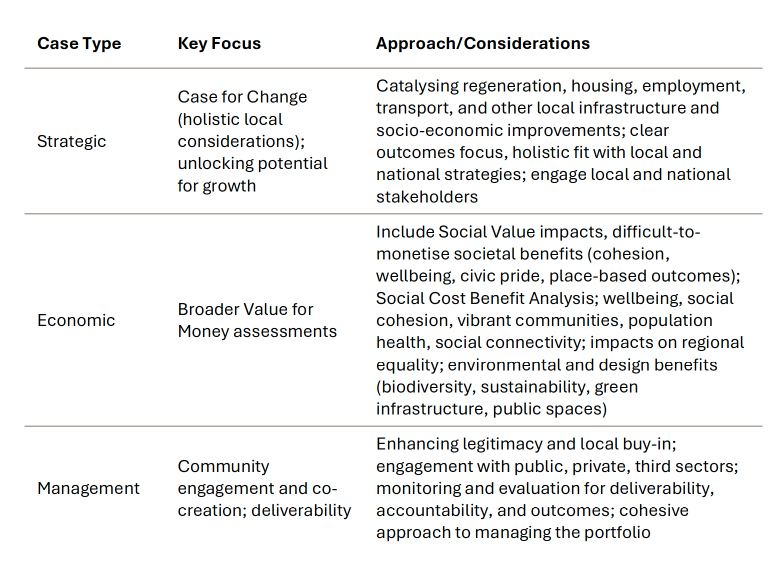
The table below outlines the key dimensions of PBBCs, providing a structured overview of their core focus areas and the approaches required for successful development. This nuanced approach addresses specific priorities, ranging from unlocking local growth and regeneration to ensuring VfM and fostering community engagement. By integrating these perspectives, authorities can ensure their PBBCs are both comprehensive and aligned with broader local and national objectives, thereby maximising the potential for impactful and sustainable outcomes.
The Capability Challenge
To support the ambitions of Place-Based Business Cases, there is growing recognition across Government of the need to strengthen local capacity and capability. Addressing the skills shortage – particularly the lack of economists, data analysts, and skilled business case authors with experience of working at scale – is vital to ensure that proposals are grounded in rigorous evidence and can withstand scrutiny. Building expertise will not only enhance the robustness of business case development but also empower local authorities to respond nimbly to changing economic realities.
Partnerships with third-party organisations can offer a pipeline of specialist knowledge, fostering a culture of knowledge transfer, upskilling, continuous improvement and evidence-led practice and must be encouraged if this approach is to be successful.
With this in mind, we have developed a short survey to help Authorities assess their readiness and capability to deliver PBBCs. All respondents who complete the survey will receive an update to this report benchmarking how their Authority compares to other (anonymised) Authorities in terms of readiness to deliver robust and impactful PBBCs.
The survey can be accessed here: https://forms.office.com/e/2EYWrYsPd8
Conclusion
From now onward, Place-Based Business Cases (PBBCs) – particularly Regional SOCs – will be central to understanding and prioritising regional regeneration, housing, employment, and infrastructure investment opportunities, and will be key to unlocking IS8 funding. For Mayoral Authorities, understanding readiness to deliver these critical Regional SOCs is key to ensuring that the right skills are in place at the right time, and that the portfolio of investments will deliver wide social, economic, and environmental impacts.
By embedding holistic assessments into the decision-making process, Mayoral Authorities can prioritise new investments that are responsive to both immediate requirements and long-term ambitions. Ultimately, the success of Place-Based Business Cases will depend on a continuing commitment to robust analysis, inclusive engagement, socio-economic evaluation of outcomes that goes beyond traditional Return on Investment and Cost-Benefit ratios, and adaptive learning across all levels of government. This is at the heart of the 2026 adjustments to the Green Book guidance on business cases and an accelerator of local economic growth and well-being.
GET IN TOUCH